El Cuco’s transformation
The Outsider (Stephen King Edition)El Cuco’s transformation is not an instantaneous disguise but a recurring process that links murder to concealment and the gradual adoption of a new identity. Holly Gibney describes a sequence in which the creature kills, marks its next target, then withdraws to a chosen hiding place while changing into that person. The process makes the new appearance part of a larger strategy: the target becomes both the object of an attack and the creature’s next self.
The Pattern of the Change
Holly reconstructs the pattern through the events involving Terry Maitland and Heath Holmes. After the Howard girls are killed, the outsider appears at the Heisman Memory Unit on April 26, while Heath is away in Regis. Holly considers whether it could have been anyone the creature was seeking, but believes it had Terry in mind because the Maitlands were visiting from out of state. The visit also leaves evidence that can incriminate Heath, including hair from one of the murdered girls; in Holly’s account, the outsider’s actions at the unit serve the double purpose of framing Heath and marking Terry.
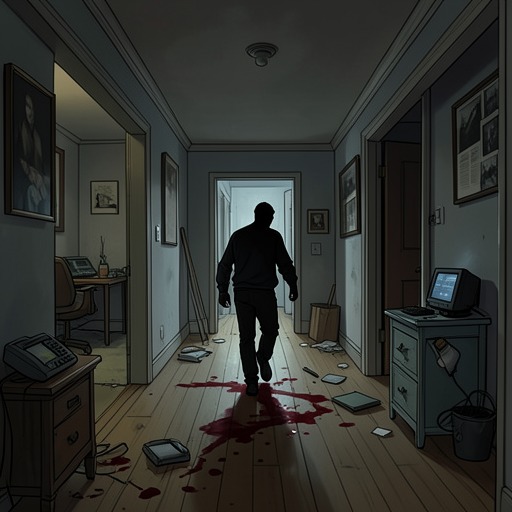
The marking is the hinge between one cycle and the next. Holly says that the creature spills Terry’s blood at the Heisman, just as it later spills Claude Bolton’s. Her formulation makes the order consequential: the murders come first, then the next victim is marked, and only afterward does the creature go into hiding. Transformation is therefore tied to the selection of a successor identity, rather than presented as a free-standing ability to change shape at will.
Hiding and Duration
Holly compares the interval of change to hibernation. The creature has a preselected den and remains there for a period while the transformation proceeds; like a bear, it may move from time to time, but mostly stays hidden. This account gives concealment a practical role in the process: the creature withdraws from view during a vulnerable or unfinished transition, then returns after adopting its next form.
The duration remains uncertain, and the discrepancy between legend and Holly’s estimate is explicit. Yune Sablo observes that the legends describe transformations lasting years, perhaps generations. Holly rejects that scale for the process she believes is underway, estimating weeks, or at most months. Her estimate is based on the specific change from Terry Maitland to Claude Bolton, not on a general claim that every traditional account is accurate. The novel thus places inherited folklore beside an active investigation: legend supplies a framework, but the investigators must infer the process’s actual timetable from recent events.
Appearance and Identity
Holly suggests that the transformation may be visibly incomplete for a time. During the change from Terry to Claude, she says, the creature’s face might appear as though made of Play-Doh or as if it had been badly burned. Ralph Anderson rejects the account, while Jeannie Anderson presses the practical difficulty: if such a figure was present, why did it not appear in any footage? The disagreement keeps the transformation from becoming an uncontested explanation. Holly offers a model that connects the evidence; Ralph’s disbelief and Jeannie’s question register the gap between that model and what can be documented.
The change appears to involve more than external resemblance. When Ralph asks whether a creature replicating Heath could gain access to his memories, Holly allows that it might, at least to a degree. That possibility helps explain how the outsider could know that Terry planned to visit his father, but Holly does not claim a complete or precisely defined transfer of memory. Transformation, in her account, joins appearance to some acquisition of the person’s identity, while leaving the limits of that acquisition unsettled.
Evidence, Doubt, and Recurrence
The theory is built by aligning details that initially seem separate: the outsider’s appearance at the Heisman, the marking of Terry, the later resemblance to Claude, and the hidden interval between attacks. Holly treats the repeated pattern as evidence that the changes are connected. Yet the explanation is presented through a conversation among investigators and family members, not as a direct, fully observed account of the creature’s biology. Ralph’s refusal to accept it and Jeannie’s demand for an explanation of the missing footage preserve the conflict between a coherent supernatural hypothesis and the ordinary standards of proof.
A small earlier detail illustrates how bodily contact can become retrospectively significant without proving the transformation theory on its own. Claude recounts that Terry’s pinky nail nicked his hand during a handshake, leaving a small scab. Claude associates the mark with the long nails he remembered from his years around drug users, and the detail gains a different weight once Holly identifies Claude as the next form into which the outsider is changing. The evidence supports the recurrence of blood and bodily marking in Holly’s account; it does not establish that Claude’s handshake injury was itself the supernatural mark she describes.
The broader pattern also intersects with Jack Hoskins’s account of the creature’s reach and the danger of pursuing it. At a stakeout, Jack waits near the cave with a Winchester rifle, taking water and pills and using cocaine before settling in to watch the entrance. When he concludes that the investigators are not coming that day, he hears—or imagines—the agreement of the man with the finger tattoos, followed by the expectation that he will return the next day. The scene does not explain the transformation’s mechanics, but it reinforces the story’s uncertainty about what can be seen, where the outsider is, and how much of an encounter takes place in the ordinary physical world.
Narrative Significance
El Cuco’s transformation makes resemblance an unstable basis for identity and accusation. In Holly’s reconstruction, a killer can become recognizably like someone else, use what it has learned of that person, and leave evidence that directs suspicion toward an innocent scapegoat. The change therefore connects the supernatural premise to the investigation’s central problem: appearances and clues can seem mutually confirming while pointing toward the wrong person.
The process is also defined by a rhythm of repetition rather than a single revelation. Killing, marking, hibernation, and reappearance form a pattern that lets Holly interpret events across different people and places. But the pattern never removes uncertainty: the timeline is an estimate, the degree of memory transfer is qualified, and the proposed temporary appearance remains absent from the footage Jeannie cites. The transformation offers a structure for understanding the evidence while leaving the reader with the same tension that confronts the investigators—an explanation may cohere without becoming easy to prove.